Real client IPs through the stream hop, with PROXY protocol
· 6 min read
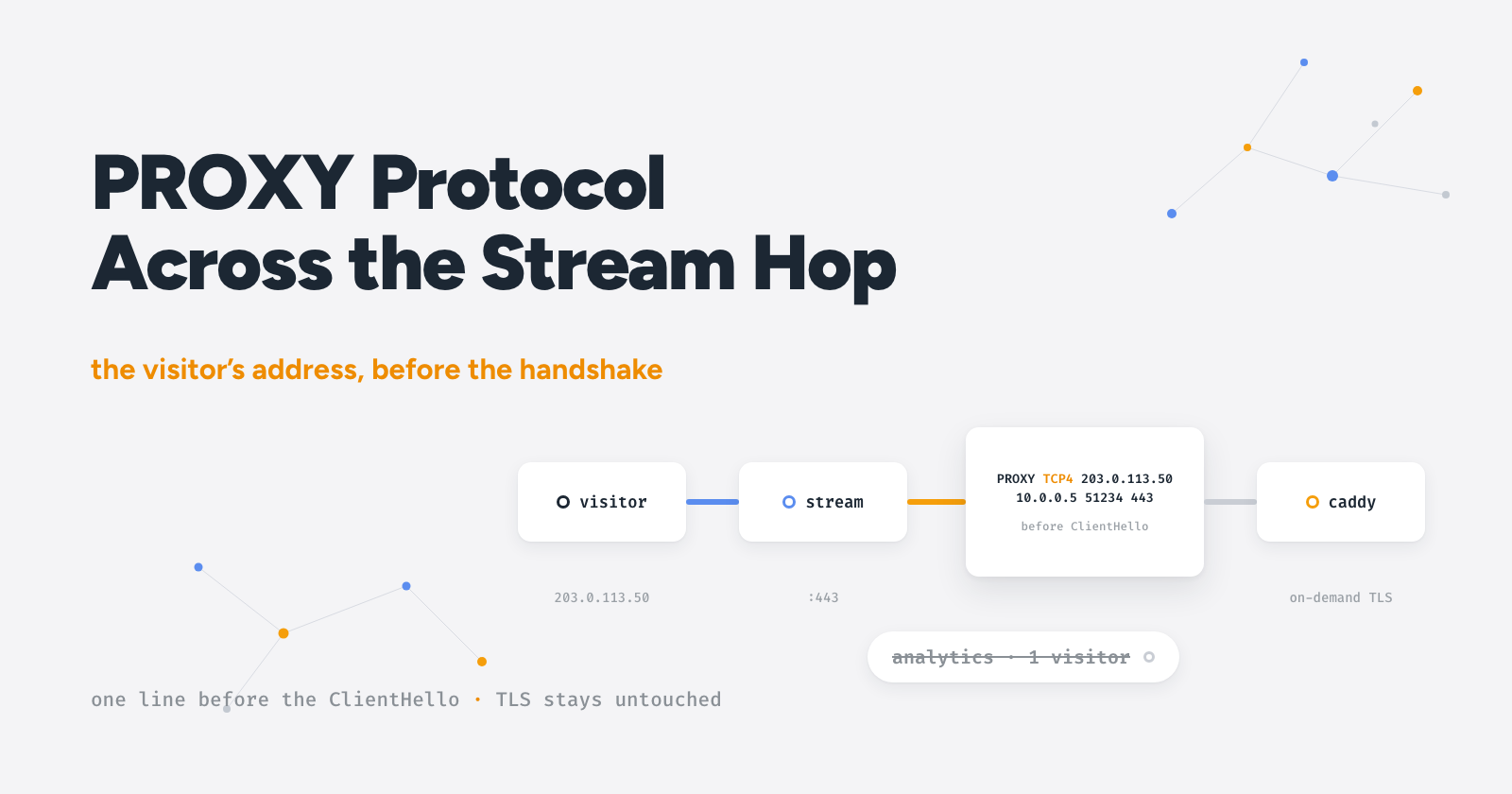
At the end of the unix socket swap I left a loose end: my analytics for customer domains had quietly turned into one visitor. The stream block forwards raw TCP, so nothing downstream knows who connected — and once the hops moved to sockets, downstream doesn't even get an address. The peer on a unix socket is just "unix".
This post is the fix: PROXY protocol across the same sockets, and what it took to get Caddy and Nginx to speak it.
Why the address disappears
The stream server terminates nothing. It peeks at the SNI, picks a backend, and copies bytes from one file descriptor to another. It never parses HTTP, so it can't add headers — there's no HTTP to attach anything to. And it can't decrypt to find out either; that's the whole point of the hop.
So Caddy's idea of the remote address is Nginx's connection, and the app's idea is Caddy. Rate limiting, abuse blocking, logs, analytics: they all see one client. The socket swap made it starker — over loopback TCP at least everyone agreed on 127.0.0.1; over a unix socket the peer address is a path that tells you nothing.
What PROXY protocol is
A short plaintext line that the stream block prepends to the connection, before the TLS handshake:
PROXY TCP4 203.0.113.50 10.0.0.5 51234 443
The backend reads the line, strips it, and treats 203.0.113.50 as the connection's remote address. TLS then proceeds untouched — the ClientHello is byte-for-byte what the visitor sent.
One thing to be clear about: the header is a claim, not proof. Whoever can connect to a PROXY-protocol listener can send PROXY TCP4 1.2.3.4 ... and impersonate any IP, which quietly defeats rate limits and bans. This is where the 0750 socket directory from the last post stops being a nice-to-have: only Caddy and the Nginx group can reach these listeners at all. On loopback TCP, every process on the box could.
Sending it from stream
server {
    listen 443;
    ssl_preread on;
    proxy_pass $https_backend;
    proxy_protocol on;
}
The trap is that this is all-or-nothing. proxy_protocol on prefixes every connection this server forwards, including the ones headed for the main app. Every backend in the map must accept PROXY protocol, or none of them can.
The Caddy side
Caddy speaks PROXY protocol through a listener wrapper:
{
    http_port 8082

    on_demand_tls {
        ask http://127.0.0.1:8000/internal/domain-check
    }

    servers unix//run/app-sockets/caddy-tls.sock|0666 {
        protocols h1 h2
        listener_wrappers {
            proxy_protocol
            tls
        }
    }
}
Three details, and I hit all three:
- The directive is
listener_wrappers. I typedlisten_wrappersfirst and gotunrecognized servers option. - Order matters.
proxy_protocolmust come beforetls, because the PROXY line arrives before the ClientHello. Reverse them and Caddy tries to parsePROXY TCP4...as a TLS handshake. - Scope it to the socket. A bare
servers { }applies to every listener, including plain HTTP on 8082 — and atlswrapper on an ACME port breaks HTTP-01 challenges and the redirect. The address afterservershas to match the listener Caddy actually creates, and a mismatch fails silently:caddy validatestill passes. Check it with adapt:
sudo caddy adapt --config /etc/caddy/Caddyfile --pretty | grep -n -B3 -A10 listener_wrappers
You want proxy_protocol then tls inside a server whose listen is the socket path. If the block is missing, copy the exact "listen" string from the adapt output into the servers line.
(protocols h1 h2 is there because the socket carries TCP only — there's no UDP on it for HTTP/3.)
The main app has to accept it too
The other backend in the map is Nginx's own http server. Its listen line gains a parameter, plus two directives to actually use the header:
listen unix:/run/app-sockets/nginx-app.sock ssl proxy_protocol;

set_real_ip_from unix:;
real_ip_header   proxy_protocol;
proxy_protocol on the listen line makes Nginx parse the line. set_real_ip_from together with real_ip_header proxy_protocol makes it use the line to set $remote_addr. You need both — parse alone just strips the header and leaves you back at "no useful address". For a unix socket peer, the trusted source is unix:.
Because one side now sends the header and the other side requires it, there's no rolling this out one backend at a time. Switch both sides together:
sudo nginx -t && sudo systemctl restart caddy && sudo systemctl reload nginx
What this buys downstream
With the wrapper in place, {remote_host} in Caddy resolves to the visitor, so anything it proxies can pass the address on:
reverse_proxy 127.0.0.1:3000 {
    header_up X-Real-IP {remote_host}
}
And in the Nginx http block, $remote_addr is the visitor again — which rate limiting and logs pick up with no further config.
How I verified it
A page that loads proves nothing. I checked each path separately, from a machine other than the server:
curl -s ifconfig.me                                # your public IP
curl -s https://timer.customer.com/check-ip        # customer-domain path
curl -s https://app.example.com/check-ip           # main-app path
Both /check-ip endpoints should print your public IP. (ifconfig.me may answer over IPv6 while your other path returns IPv4; force a family with -4 or -6 if they disagree.)
What I'd tell past me
- Treat
proxy_protocolas a change to the whole proxy chain, not one backend. Every backend in the map accepts it, or none can — and both sides switch together. - After editing
servers <address>in Caddy, runcaddy adaptand confirm the wrapper attached.validatepassing doesn't prove it. - Check real client IPs in the logs on day one, not after a week of bad analytics.
Read the series from the start: Multi-Tenant Custom Domains and the unix socket swap set up everything this post leans on.